Whitepaper
The Foundations
Framework
A governing standard for AI transformation value creation in regulated industries
A pilot can work, a business case can hold, a team can perform, and the program can still fail to scale. The decisions that determined whether it could were made before the work began.
The gap
The CFO is asking a different question.
Executives do not lack dashboards. They have milestone reports, adoption metrics, vendor scorecards, steering committee updates, implementation plans, and benefits-tracking models. Those instruments matter. They help manage the program. They do not govern whether the program should exist.
The CFO is not asking whether the pilot worked. The CFO is asking whether this is the best use of the institution’s next dollar of capital. Most transformation programs are not built to answer that question, and they discover it in the room where the next phase is funded.
Program success and enterprise-scale value creation are not the same standard.
The model
The best frameworks do not replace executive judgment.
They discipline it.
Porter’s Five Forces did not tell executives what strategy to choose. It gave them a structured way to see where economic value could be created or defended before they chose. The Foundations Framework applies that discipline to AI transformation and to the capital decisions that determine whether it scales.
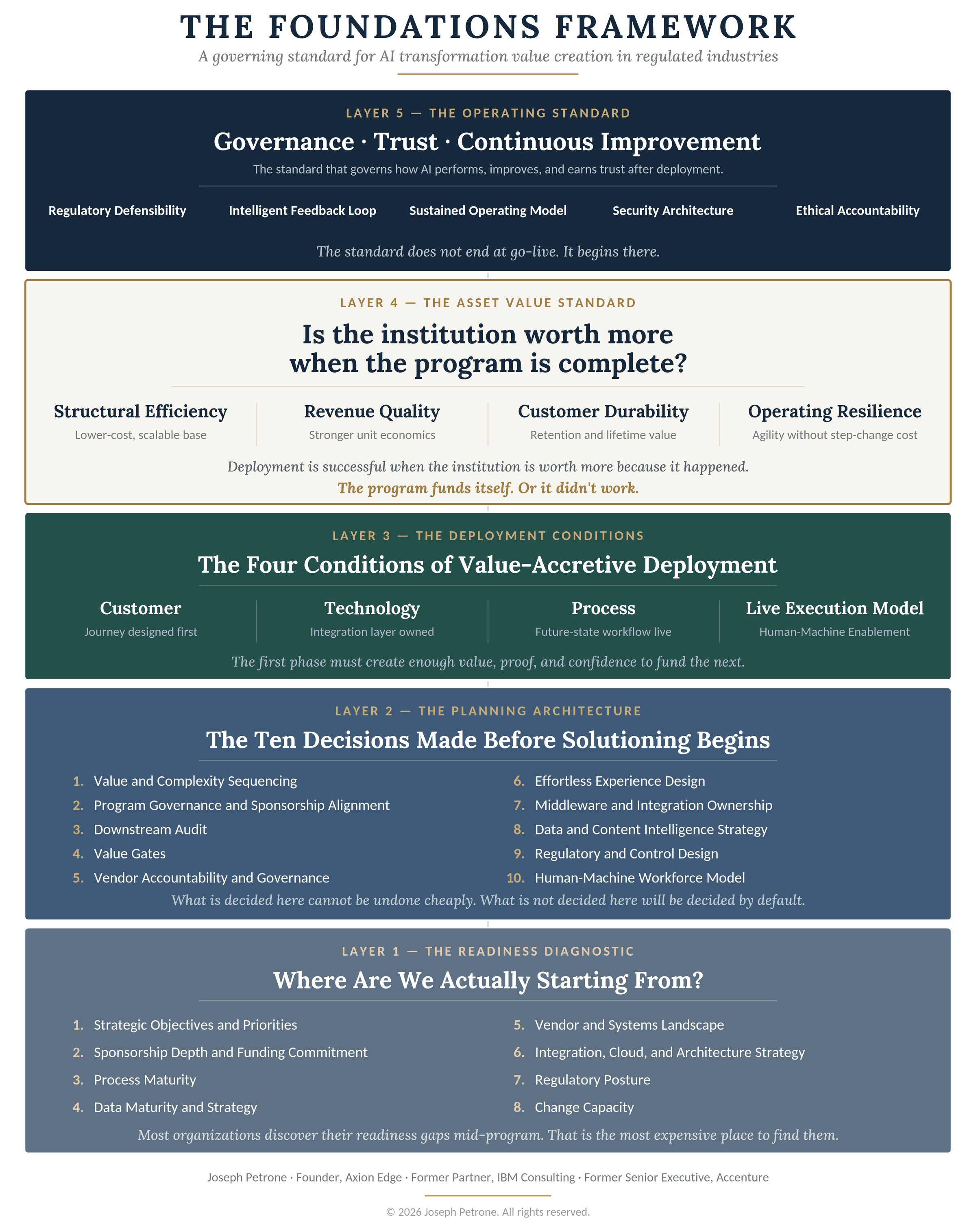
The five layers
Each layer depends on the integrity of the one beneath it.
-
Layer 5
The Operating Standard
The standard does not end at go-live. It begins there.
-
Layer 4
The Asset Value Standard
Is the institution worth more when the program is complete?
-
Layer 3
The Deployment Conditions
The first phase must create enough value, proof, and confidence to fund the next.
-
Layer 2
The Planning Architecture
What is decided here cannot be undone cheaply. What is not decided here will be decided by default.
-
Layer 1
The Readiness Diagnostic
Most organizations discover their readiness gaps mid-program. That is the most expensive place to find them.
The governing thread is asset value: discovered, sequenced, delivered, measured, and protected across the full life of the program.
The measure
Is the institution worth more when the program is complete?
That answer is not vague. It becomes measurable across four dimensions.
Structural Efficiency
More output per dollar of expense.
Revenue Quality
Stronger economics per customer relationship.
Customer Durability
A more resilient earnings stream.
Operating Resilience
The ability to adapt without repeated reinvestment.
When those dimensions move, enterprise value moves.
The commercial logic
Phase 1 must earn Phase 2.
A program sequenced correctly creates value early enough, visibly enough, and materially enough to fund its next phase. Over its arc it pays for itself from the value it creates, rather than returning to the board for a fresh act of faith at every milestone.
When the first phase is selected for time to measurable value, the Go/No-Go conversation changes. The question is no longer what the next phase costs. The question becomes where else the institution can create value.
The constraint was never only budget. It was sequence.
Next step
The paper is open.
The briefing is where the work begins.
Twelve pages on the governing standard, the five layers, the Asset Value Standard, and the self-funding model. Read it before the next Go/No-Go.
About the author
Joseph Petrone Founder, Axion Edge · Former Partner, IBM Consulting · Former Senior Executive, AccentureJoseph Petrone launched Accenture’s enterprise AI practice in 2014 and later led IBM Consulting’s AI Customer Transformation practice. His work focuses on the governance, sequencing, and operating conditions required to turn AI programs into durable institutional value.